
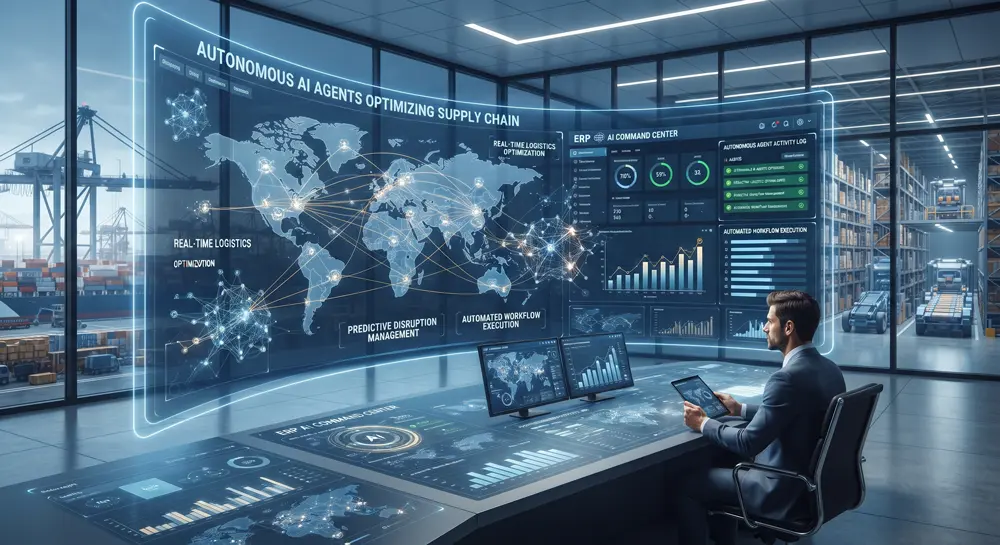
The dynamics in global logistics and production networks have necessitated a fundamental shift in how enterprises utilize corporate software. In recent years, artificial intelligence in ERP systems was largely limited to static dashboards, historical reports, and basic demand forecasting that required mandatory human intervention for interpretation and execution. Today, the focus is definitively shifting toward the deployment of autonomous AI agents (agentic workflows) capable of not only analyzing anomalies but also executing complex multi-step operations in real time.
How Autonomous Agents Work in an ERP Environment
High-end software solutions are integrating specialized digital agents directly into the core of ERP platforms (such as SAP S/4HANA or Oracle SCM). Unlike standard chatbots or passive algorithms, these systems feature three key characteristics:
-
Autonomous Planning and Orchestration: Breaking down complex goals (such as raw material shortages or delayed shipments) into small steps, checking inventory levels, analyzing alternative suppliers, and preparing corrective orders.
-
Operation Without Continuous Human Supervision: Under pre-defined boundaries and business rules (guardrails), agents can automatically approve routine transactions, update production schedules, and reroute logistics flows.
-
Multi-System Integration: Coordinating data simultaneously from ERP purchasing and sales modules, external shipment tracking platforms, and communication channels, thereby eliminating manual data transfer.
Practical Benefits for Logistics and Manufacturing Companies
Integrating intelligent agents into supply chain management leads to measurable business outcomes:
-
Minimizing Errors During Emergencies: In cases of logistics blockades or shipment delays, the system instantly identifies affected customer orders and suggests alternative routes within seconds.
-
Optimizing Working Capital: Through continuous data collection (demand sensing), more precise inventory levels are maintained, reducing capital blocked in excess raw materials.
-
Significantly Reducing Transaction Time: Routine processes such as invoice processing, delivery matching, and compliance certificate verification are executed with 70–80% fewer manual interventions.
Implementing such technological solutions into an enterprise's existing infrastructure, however, requires exceptional precision, clean data, and architectural compatibility.
At Transpot.net, we develop and optimize both custom websites and complex CRM and ERP systems built and supported by the capabilities of artificial intelligence. If you want to transform your business management and prepare your processes for entirely new levels of automation, contact us to discuss a tailored solution for your needs.